Badrinath
Badrinarayan Temple
Mahavakya
Ayam Atma Brahma
This Self is Brahman
A Portal of Twenty Chapters
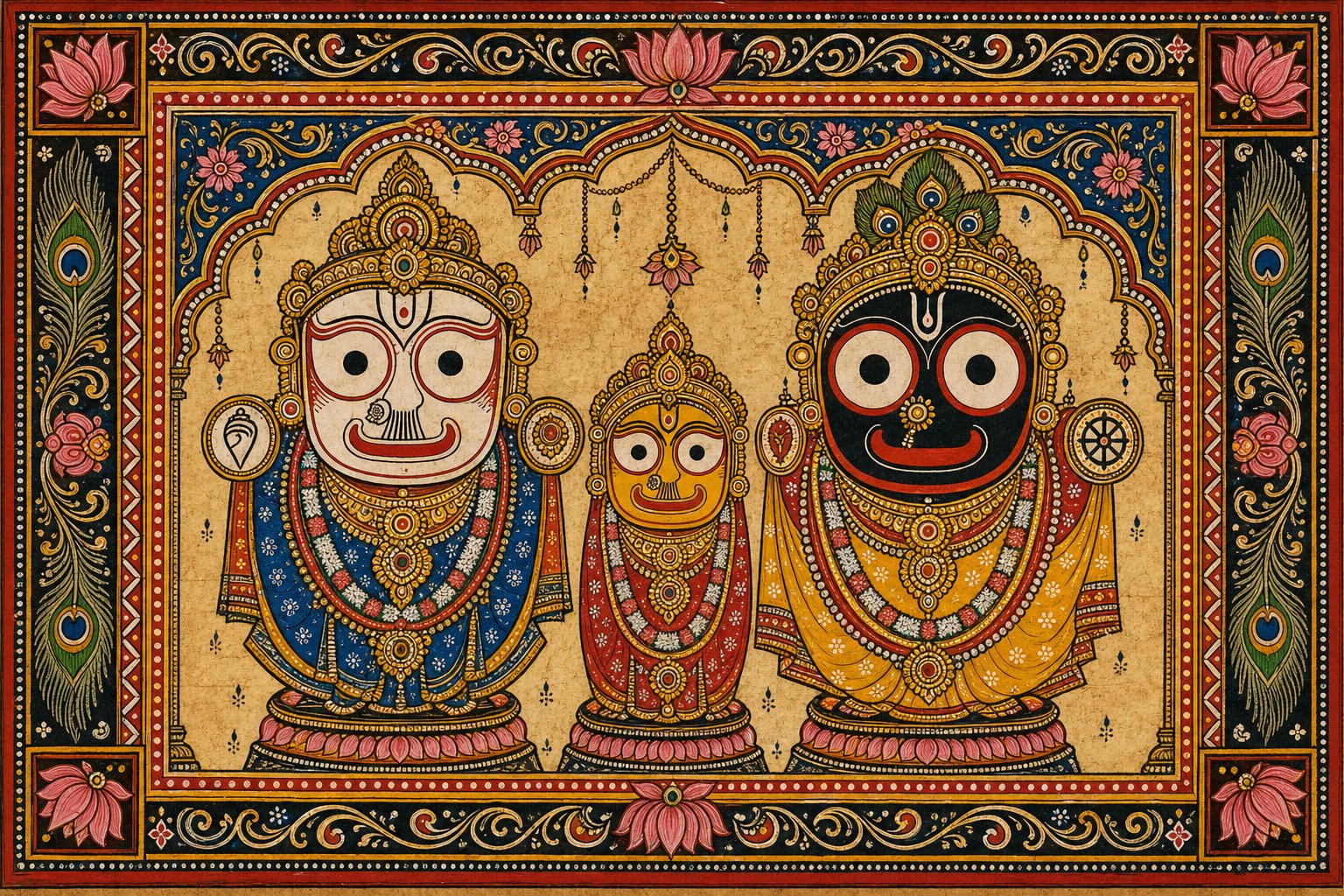
Wooden god of round eyes and unfinished arms. Carved by a mysterious carpenter, ridden on chariots taller than temples, loved by tribal chiefs, Muslim poets, saints, and kings. Twenty chapters, two voices, two thousand years. Enter any door.
The Framework of the Four Dhamas
Many centuries ago the Indian subcontinent was spiritually fragmented — into Shaivism, Vaishnavism, Shaktism, Tantra, and countless non-Vedic currents. In the 8th century, Adi Shankaracharya walked from the deep south to the high Himalaya and chose four sacred sites at the four extremities of the subcontinent — Badrinath in the north, Rameswaram in the south, Dwarka in the west, and Puri in the east — to build a single national framework for spiritual unity.
To make it endure, he founded four cardinal monasteries (mathas), placed one of his four chief disciples at the head of each, and assigned every seat responsibility for preserving a specific Veda and a Mahavakya — one great Upanishadic truth. Each Dhama was also symbolically linked to a cosmic age.
Badrinarayan Temple
Ayam Atma Brahma
This Self is Brahman
Ramanathaswamy Temple
Aham Brahmasmi
I am Brahman
Dwarkadhish Temple
Tat Tvam Asi
Thou art That
Jagannath Temple
Prajnanam Brahma
Consciousness is Brahman
In popular pilgrim tradition, the four Dhamas trace the daily routine of Lord Vishnu — He bathes at Rameswaram, meditates at Badrinath, dines at Puri, and rests at Dwarka.
The Eastern Seat — Jagannatha Dhama
Puri sat on the eastern coast along the Bay of Bengal, balancing Badrinath in the north, Rameswaram in the south, and Dwarka in the west. Puri’s synthesis of traditions aligned with Shankara’s philosophy — Lord Jagannath was worshipped not as a sectarian deity but as Purushottama, the Supreme Being. Jagannath culture assimilated tribal origins (the Sabara tradition), Tantric rites, Shaivism, Shaktism, and Vaishnavism under one roof.
To secure Puri as the eastern spiritual seat, Shankara founded the Govardhana Matha around 800 CE near the Jagannath Temple. He appointed his chief disciple Padmapadacharya as the first Shankaracharya of the seat, and assigned it the Rig Veda.
By establishing Puri as the site where the Lord dines, Shankara elevated the sacred Mahaprasad tradition into a central pillar of national pilgrimage.
Sacred Landmarks & Living Rituals of Srimandira
The Grand Road, the Twenty-Two Steps, the Blue Wheel, the flag that flutters against the wind, the twelve annual journeys, thirty-two changes of costume, and a Krishna who walked from Vrindavan to bear witness. Every stone at Puri carries a story. Tap any card to open the account.
Built centuries ago as a ceremonial path, Bada Danda in Puri stretches from the Jagannath Temple to the Gundicha Temple. Beyond serving as the main street of Puri, it holds immense spiritual, philosophical, and cultural importance in Jagannath culture. It is lined with historic monasteries (Mathas), shrines, and sacred sites.
Beyond its ritualistic role, Bada Danda functions as the cultural pulse of Puri, hosting public gatherings, holy discourses, vendor markets selling religious artifacts and Mahaprasad, and major processions throughout the year.
The name combines two words — "Saradha" and "Bali" (Odia for "sand"). Thousands of years ago a river flowed through the Puri Bada Danda, dividing it into two parts. During the earliest Rath Yatra, chariots could not reach the Gundicha temple directly.
King Indradyumna first built six chariots. He took the deities in three chariots to the banks of the Malini River, transferred the idols to three large boats to cross, and used three more chariots on the far bank to reach Gundicha. It was very difficult to pull the chariots through sand and to build six chariots every year.
In the 13th century, Queen Saradha Devi resolved to end this hardship. She approached Gajapati Maharaja Vanudev to fill the Malini River with sand so that the three chariots could go straight to the Gundicha temple. When Vanudev heard this he smiled and said, "Have you got a headache? Is it so easy to fill the river?"
The queen said, "Give me some money from the treasury. I will go and start sanding the river." Yet the king could not believe her. Finally the queen said, "We have started the work of sand-filling. Then our next generation can ever finish this work. So give me the responsibility of doing this work."
At last the Gajapati agreed. Before the Rath Yatra that year, the Malini River was filled with sand. The astonished king renamed the place Saradha Bali to remember the holy thought of the queen.
Singha Dwara symbolises Dharma (righteousness) among the four gates, representing the ultimate entry point for spiritual seekers striving for liberation (Moksha). According to local belief and pilgrim experience, the roaring sound of the nearby ocean waves (Samudra Swana) is distinctly audible right up to the threshold of Singha Dwara — but the moment you cross the gate’s inner frame, the sound completely ceases.
The deities present at Singha Dwara are Kasi Biswanath, Goudia Nrusimha, and Bhagya Hanuman.
In front of the Singha Dwara stands the Aruna Stambha — the pillar of Aruna, the dawn — rising to a height of 34 feet from the ground.
Twenty-two steps at the Puri Jagannath Temple, known as the Baisi Pahacha, connect the Singha Dwara to the inner courtyard. After entering the Singha Dwara, devotees climb these 22 holy steps to reach the second inner gate (Baisi Pahacha Gumuta), and past that gate they reach the courtyard from which they may enter the main temple.
Each step measures roughly 70 feet long and 6 feet wide. A black stone known as Yama Shila is engraved in the middle of the third step. Devotees are advised to step on this stone on the way up — it frees them from Yama Danda, the punishment of Yama, the lord of death — but must not step on it on the way back, since doing so would take away all the punya (merit) earned.
On the seventh step, a small rough stone (of the kind used to build houses) is called Preta Shila or Pitru Shila. Pilgrims leave Anna Mahaprasad on it for feeding the ancestors, believed to liberate the souls of the deceased.
The Nila Chakra (Blue Wheel) atop the Jagannath Temple in Puri is a sacred 11.8-foot-tall disc with a circumference of around 36 feet, made of Ashtadhatu — an alloy of eight sacred metals (gold, silver, copper, tin, zinc, lead, iron, and mercury) that resists atmospheric corrosion.
It symbolises Lord Vishnu’s Sudarshan Chakra, acting as an ultimate divine protector, a cosmic axis linking earth to heaven, and an object of profound reverence where a mere glance is said to cleanse a devotee’s sins.
In Vaishnava tradition, seeing the Nila Chakra is considered equivalent to receiving direct darshan of Lord Jagannath himself (Chakra Darshan). Pilgrims unable to enter the temple complex often offer prayers upon sighting the wheel atop the spire from anywhere in Puri.
The Patitapabana Bana is the sacred triangular flag tied to the Nila Chakra atop the 214-foot spire of the Shree Jagannath Temple in Puri. The name literally translates to "Redeemer of the fallen" (Patita = downfallen/sinner, Pabana = purifier), reflecting its deep spiritual meaning in Jagannath tradition.
The flag is typically bright red or yellow, often measuring around 12 to 20 feet long. Every evening at sunset, hereditary servitors called Chunara Sebayatas scale the outer walls of the 214-foot stone spire — without any ropes, ladders, or safety equipment — to untie the old flag and fix a new one. This breathtaking ritual has been performed continuously for centuries without fail.
The flag famously appears to flutter in the opposite direction of the local breeze, which devotees revere as a divine miracle.
The Mukti Mandapa at Puri Dhama is a sacred 16-pillar open stone platform situated directly in front of the southern door (Dakhina Dwara) of the main sanctum, adjacent to the Adi Nrusingha temple. It serves as the highest religious and legal advisory body of pandits guiding the spiritual traditions of the temple.
The council comprises elite Vedic scholars (pandits) drawn from the historic sixteen Shasana Brahmin villages established by the Gajapati kings around Puri. The Shankaracharya of Govardhana Matha serves as its permanent supreme head.
During the periodic Nabakalebara festival — when the holy wooden forms of the deities are recreated — the scholars of Mukti Mandapa guide and oversee critical consecration rituals, including the grand fire sacrifice (Pratishtha Homa).
The word "Mukti" signifies liberation from the cycle of birth and rebirth. Pilgrims traditionally approach the Mukti Mandapa after receiving darshan of the main deities to bow, seek the blessings (ashirvada) of the assembled scholars, and receive sacred thread or flowers.
The Shree Jagannath Temple complex spans approximately 10.7 acres, encircled by a massive outer stone boundary — the Meghanada Pacheri. The name derives from two Odia words: Meghanada (the sound of thunder or roaring ocean clouds) and Pacheri (wall).
Popular belief and temple lore hold that the wall was constructed to block the loud, roaring sound of the Bay of Bengal’s ocean waves (Samudra Swana). Once a devotee steps past the gates into the enclosure, the sound of the sea vanishes, creating a peaceful space for prayer and meditation.
Built primarily as a defensive fortress wall during the reign of Gajapati King Kapilendra Deva in the 15th century CE, the wall protected the Srimandira complex, its sacred treasures, and its deities against external invasions and desecration during turbulent historical periods.
The Meghanada Pacheri separates the outer world (Bada Danda and Puri town) from the inner realm (Kshetra). Within its boundaries lie not only the main temple (Deula) but also the Ananda Bazar (world’s largest open-air food market), sacred gardens, kitchens (Rosa Ghar), and administrative shrines.
The Patitapabana form is a solitary idol of Lord Jagannatha. The name comes from Odia and Sanskrit: "Patita" meaning the fallen or distressed, and "Pabana" meaning the purifier or redeemer.
He is positioned facing east, aligned directly with the Bada Danda (Grand Road). Anyone standing outside on the Grand Road can clearly see His round eyes (Chaka Akhi) without stepping past the threshold or climbing the twenty-two holy steps (Baisi Pahacha).
Because traditional temple rules restricted entry to the main sanctum for various historical, social, or personal reasons, the idol of Patitapabana was permanently placed at the Singha Dwara — so that the Lord could be seen by all, without exception.
The word "Mangala" means auspicious. The ritual symbolises dispelling the darkness of the night and ushering in divine light and cosmic order for the universe.
The Mangala Alati (or Mangala Aarti) at the Shree Jagannath Temple in Puri is the first and most sacred daily ritual (Niti) performed to awaken Lord Jagannatha, Lord Balabhadra, and Devi Subhadra. Performed around 5:00 AM every morning — and earlier during holy months like Kartika and Pausha — it holds profound spiritual, cultural, and symbolic significance in Jagannath culture.
During Mangala Alati, the deities are viewed in their divine bedtime attire (Bada Shringara Besha) adorned with sweet-smelling floral crowns (Tahia) and silk dresses decorated with Odia devotional verses (Gita Govinda) worn the previous night. Witnessing the deities in this form is considered spiritually purifying.
Old Sanskrit texts, from the Brahma and Skanda Puranas onwards, prescribe the observance of twelve festivals in the temple of Jagannatha throughout the year — the Dwadasa Yatras ("twelve journeys"). In practice, more than fifty-six festivals are observed at Srimandira across the year; the twelve are the pillars that anchor the calendar.
They are: Snana Yatra — the bathing festival on Jyestha Purnima, when the deities are bathed with 108 pitchers of water from the Suna Kua and then retire to the Anasara Pindi for fifteen days; Ratha Yatra — the great chariot festival in Asadha, when Balabhadra, Subhadra, and Jagannath ride the Taladhwaja, Devadalana, and Nandighosa chariots to the Gundicha Temple; Sayana Yatra — the ritual sleep of the deities on Ashadha Sukla Ekadasi, mirroring Vishnu's cosmic slumber on Seshanaga in the ocean of milk; Dakshinayana Yatra — marking the sun's turn towards the autumnal equinox at Karkata Sankranti; Parswaparivartana — on Bhadraba Sukla Ekadasi, the sleeping deities turn to their other side; Uttarayana Yatra — at Makara Sankranti, when Makara Chula, a sweet made of raw rice, coconut, ghee, and jaggery, is offered as bhoga; Hari Utthapana — Kartika Sukla Ekadasi, when the deities rise from their four-month monsoon slumber; Prabarana Sasthi (also Odhana Sasthi) — in Margasira, the Ghodalagi begins and the deities are wrapped in coloured woollen cloth for the cold season, until Basanta Panchami; Pushyabhiseka — on Pausa Purnima, the deities appear in Suna Besha on the Ratnasimhasana, echoing Rama's coronation at Ayodhya; Dola Yatra — from Phalguna Sukla Dasami to Purnami, Lord Dolagobinda, with Lakshmi and Saraswati, is taken to the Dola Vedi outside the main temple; Damanaka Chori — on Chaitra Sukla Trayodasi and Chaturdasi, Rama and Krushna proceed to Jagannath Vallabha Matha to "steal" tender Dayana leaves, which are then offered to the deities; and finally Chandan Yatra — the 42-day sandalwood festival beginning on Akshaya Tritiya, with 21 days of Bahara Chandana at Narendra Tirtha tank and 21 days of Bhitara Chandana inside the temple.
Together they trace the whole year in the Lord's own body — bathing, sleeping, turning, rising, and finally cooling in sandalwood as the summer returns.
Lord Jagannatha, Lord Balabhadra, and Devi Subhadra are attired in a rotating cycle of costumes — the Veshas — made of cotton and silk, gold ornaments studded with precious stones, tulasi leaves, and flowers of many kinds. Sandal paste, camphor, and sometimes musk are applied for the daily and periodical rituals. Traditionally the deities take on thirty-two Veshas across the year, each tied to a specific festival, tithi, or hour of the day.
The morning begins with Abakash Besha (also called Tadapa Uttari Besha), performed between six and six-thirty AM after Mangala Alati, when the deities are dressed in cotton for their ritual toothbrush and bath. During Snana Yatra the deities appear in Hati Besha (also Gajanana Besha), wearing large elephant-head masks — the costumes for which are brought from Gopala Tirtha Matha for Balabhadra and Raghava Das Matha for Subhadra and Jagannatha.
The most beloved and mysterious is the nightly Bada Shringara Besha — performed around ten PM before the deities are put to rest. "Bada" means great; "Shringara" refers to the conjugal love of the gopis and Radharani for Krishna. The Pandas hold that at this hour every evening, Radha and the gopis come unseen to see Jagannatha. The deities are wrapped in Gita Govinda Khandua — twelve-foot red silk cloths bearing verses from Jayadeva's Gita Govinda, which is dear to the Lord — and adorned with the eight floral ornaments: Candrika with Alakapanti (a forehead decoration entirely of flowers), Puspatilaka (a flower tilaka), Karapallaba (finger-decorations of Dayana leaf and flowers), Makara Kundala (shark-shaped flower earrings), Padaka (a round chest-covering some eighteen inches across), Guna and Jhumpa (nose ornaments), Puspa Mala (long flower garlands running from arm to arm), and a Tulasi Mala crown wound on strips of bamboo.
Other Veshas mark the Krishna Lila cycle in Bhadraba — Banabhoji (the picnic in the forest with Balarama and the cowherd boys), Kaliyadalana (Krishna subduing the serpent Kaliya), and Pralambasura Badha (the killing of the demon Pralamba) — each dressing the Lord as the story of that day.
About twenty kilometres west of Puri, on the Puri–Bhubaneswar highway, stands the medieval Kalinga-style Satyabadi Gopinatha Temple — better known as Sakshigopal. "Sakshi" means witness; the deity here is Krishna as Gopala, who walked from Vrindavan to Odisha to bear witness to a promise.
The story is a famous one. A poor young man of a village fell in love with the headman's daughter, but the headman refused the marriage on account of the difference in station. In time the villagers, both men among them, went together on pilgrimage to Vrindavan. On the way the headman fell gravely ill and was abandoned by all — except the young man, who nursed him back to health. In gratitude the old man promised, before the Gopala deity in Vrindavan, to give his daughter in marriage.
After they returned home the headman changed his mind and demanded a witness. The young man returned to Vrindavan and prayed to Gopala — who, moved by his devotion, agreed to come himself, on one condition: the youth would walk in front and never look back; Gopala would follow behind, and his footsteps could be heard. So they set out. Near a mound of sand on the way, the youth could no longer hear the footsteps. He turned. In that instant, Gopala became a stone image, rooted forever to that spot.
The villagers gathered in wonder that God himself had come to bear witness. The young man and the headman's daughter were married. They and their descendants became the first priests of the temple built in Gopala's honour, on the very ground where the deity had halted.
The deity is said to be one of sixteen Krishna images carved by King Vajranabha, the great-grandson of Krishna, from an imperishable stone called Braja, and installed originally at Vrindavan-Mathura to keep the spirit of Krishna alive after the Kurukshetra war. Sakshigopal is one of two of these — the other, Madana Mohana, remains at Karauli in Rajasthan. In the Vaishnava pilgrimage tradition, a visit to Puri is completed by darshan at Sakshigopal — Jagannath's Krishna form arriving from Vrindavan itself.